The short version
This is a terms comparison built from both products’ own pricing pages, captured in USD on October 4, 2026. We did not create an account on either one.
The two products disagree about what a note is. Notion treats the workspace as a company brain — docs, databases, project views, sharing, and now agents — and bills every member for it. Obsidian treats the note as a local file you own, gives the app away, and sells you sync, publishing, and a commercial license as separate lines. That single design choice produces almost every pricing difference below.
If you are choosing a tool for a team, the comparison that matters is Notion vs Obsidian on cost-per-collaborator. If you are choosing for your own notes, ignore seats entirely and compare the free tiers.
Pricing side by side
| Notion | Obsidian | |
|---|---|---|
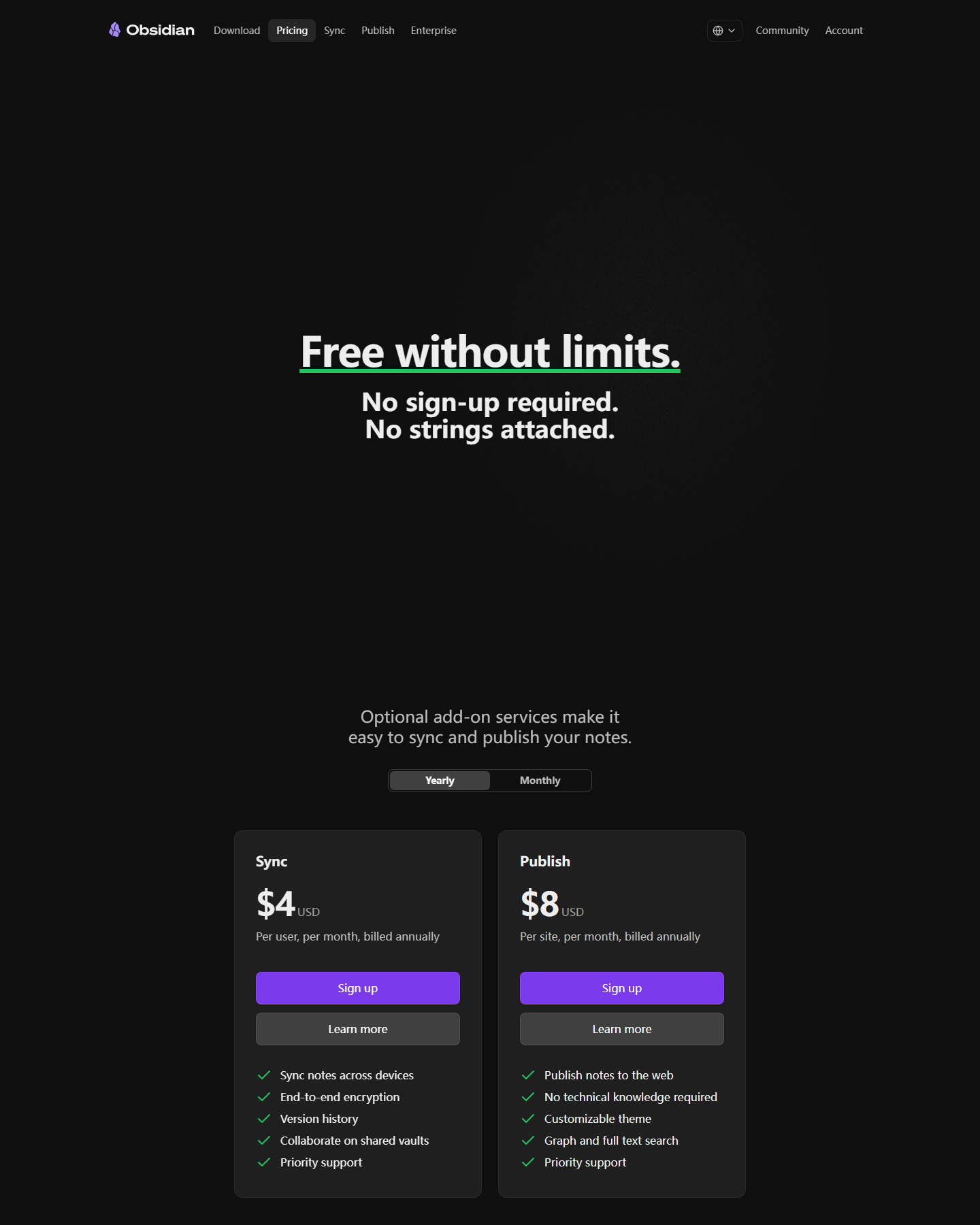
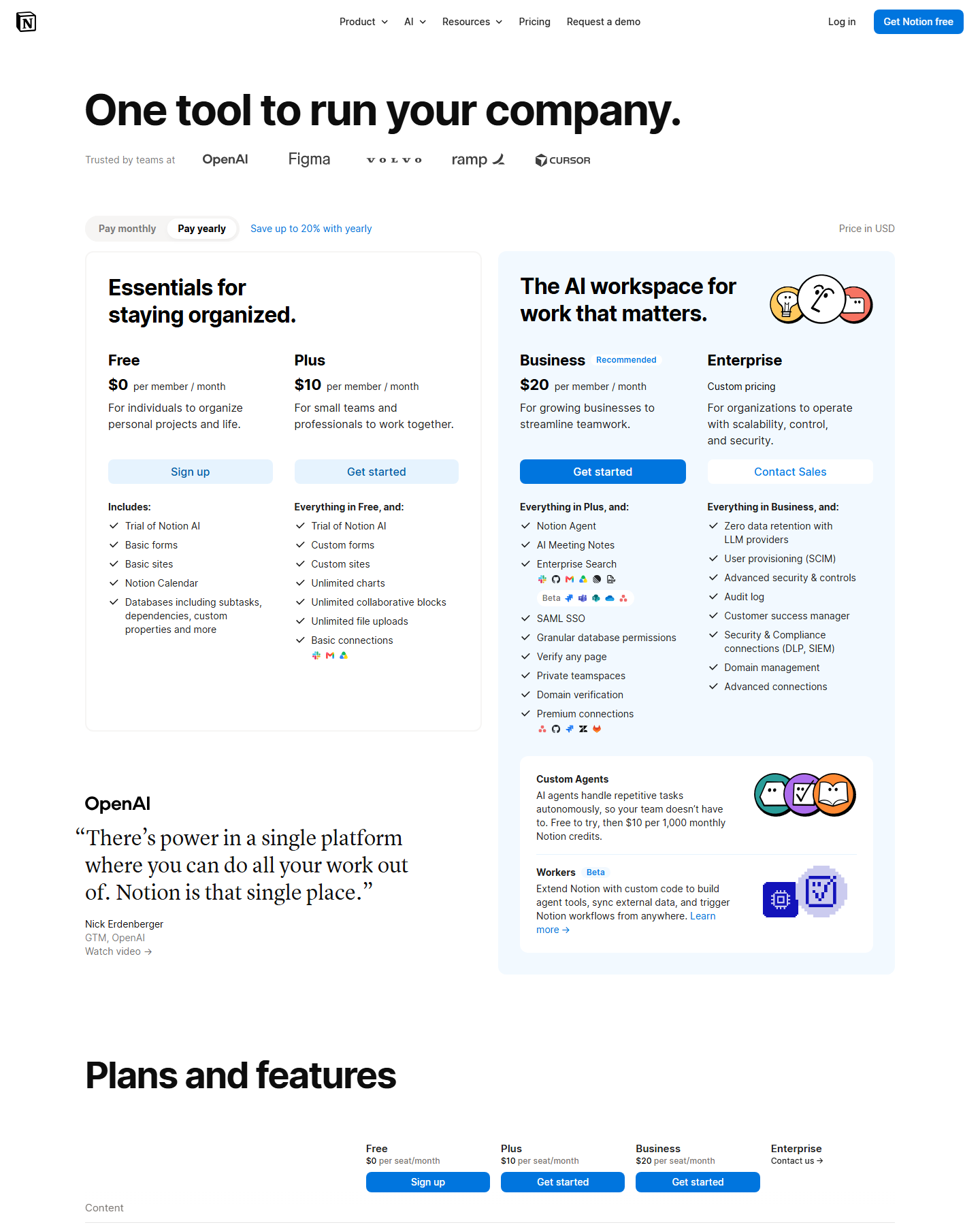
| Free tier | $0 per member/month | $0, no sign-up required |
| Entry paid plan | Plus $10/member/mo yearly · $12 monthly | Sync $4/user/mo yearly · $5 monthly |
| Next tier up | Business $20/member/mo yearly · $24 monthly | Publish $8/site/mo yearly · $10 monthly |
| One-time options | None | Catalyst $25 one-time |
| Commercial use | Included on any paid plan | Commercial license $50 per user per year (optional) |
| Enterprise | Custom | Enterprise (custom) |
| AI | Trial only on Free and Plus; full from Business $20 | No built-in AI in the app; community plugins |
Two lines here decide most purchases. On Notion, a $10 seat does not include AI — the pricing page lists “Trial of Notion AI” on both Free and Plus, and full AI starts at Business $20. On Obsidian, Sync and Publish are two separate subscriptions, so a team that both syncs across devices and publishes a public site pays $4 + $8 = $12 per user per month, which is already more than Notion Plus.
What the free plans actually give you
Obsidian’s free tier is not a trial. The pricing page states “Free without limits. No sign-up required,” and the FAQ confirms your data is stored locally on your device. The app is a local editor over your own Markdown files — there is nothing to expire and no seat count. What you lose without paying is multi-device sync, end-to-end encryption on synced vaults, version history, and web publishing.
Notion’s free tier is generous in a different way: unlimited pages, 10 free guests, 7 days of page history, databases, and calendar connections. Two limits decide most upgrades, and both are on the pricing page: file uploads cap at 5 MB each on Free, and blocks stop being unlimited once a second member joins the workspace. A solo user can genuinely run Notion free for years.
The AI line, honestly
Notion puts AI behind its $20 tier. Free and Plus get a trial of Notion AI; Business is the first tier where the page describes real capability — Notion Agent, AI Meeting Notes, and Enterprise Search across connected apps. Custom Agents are billed separately at $10 per 1,000 monthly Notion credits on every tier, including Enterprise.
Obsidian ships no AI in the app. The official page says nothing about a first-party model; the ecosystem is community plugins. If AI is a hard requirement, Obsidian’s answer is a plugin you audit yourself, which is a different risk and a different cost.
Data ownership and publishing
This is where the products are genuinely different rather than differently priced. Obsidian’s FAQ states that you can use the apps “without sharing any personal information” and that your data is stored locally on your device. Publish, when you pay for it, is what puts a vault on the public web — $8 per site per month on annual billing.
Notion is the opposite by design: sharing is the point. Guests are free on every paid plan, so external collaborators cost nothing, but the content lives in Notion’s workspace and the export path is a manual export rather than a folder you already own. Publishing on a custom domain is a separate $8/month per domain on annual billing, $10 monthly, charged on top of your tier.
What it costs a real team
- 5 people, docs and a wiki, no AI: Notion Plus $50/mo. Obsidian Sync $20/mo — but nobody can comment, there’s no shared dashboard, and publishing a client site costs $40/mo more.
- 5 people who need AI and permissions: Notion Business $100/mo is the first tier that includes real AI and SAML SSO. Obsidian has no equivalent single line; you would buy Sync plus commercial licenses ($25/mo for 5 users) and still have no shared workspace state.
- 1 person, personal notes: Obsidian free forever is the stronger offer. Notion free works too, until you need a second member or a file over 5 MB.
Verdict
Obsidian wins on cost for individuals and on data ownership, full stop — a free local app with optional $4 sync is hard to argue with. Notion wins the moment someone else needs access, because guest sharing, databases, comments and real AI have no Obsidian equivalent you can buy off a pricing page.
Read the pricing rules in our Notion pricing check and the full tier breakdown in Notion pricing. If the pull is toward leaving rather than choosing, see Notion alternatives.
Pricing verified against obsidian.md/pricing and notion.com/pricing on October 4, 2026. Both products change prices without notice — check the official pages before purchasing.