Short answer: no
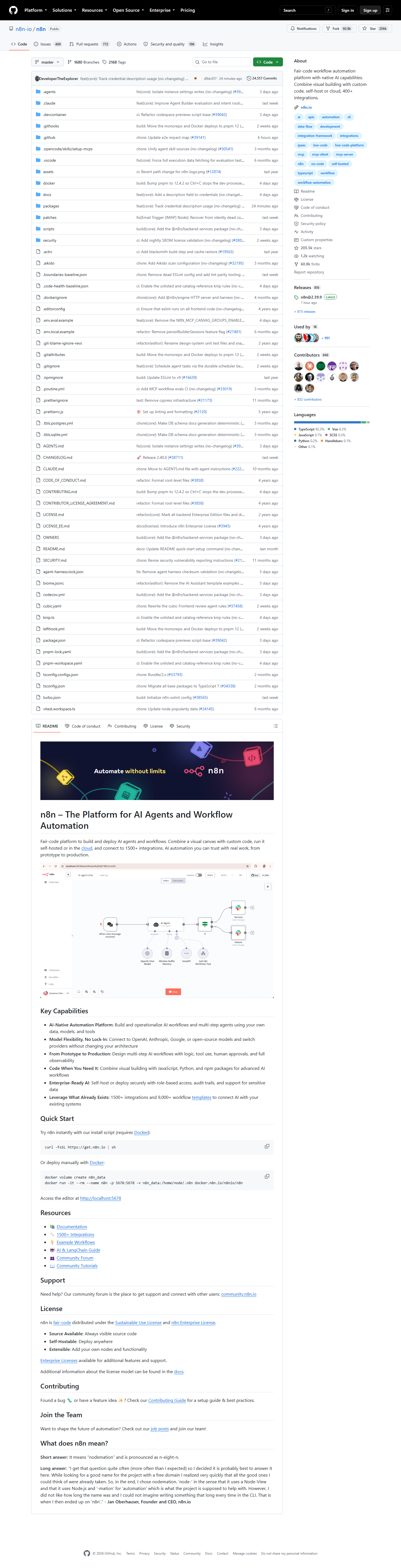
n8n is one of the most-starred “open source” projects in automation — 205,521 stars, 60,818
forks, last push 2026-09-21 (GitHub API, same-day check) — and it is not open source. Its
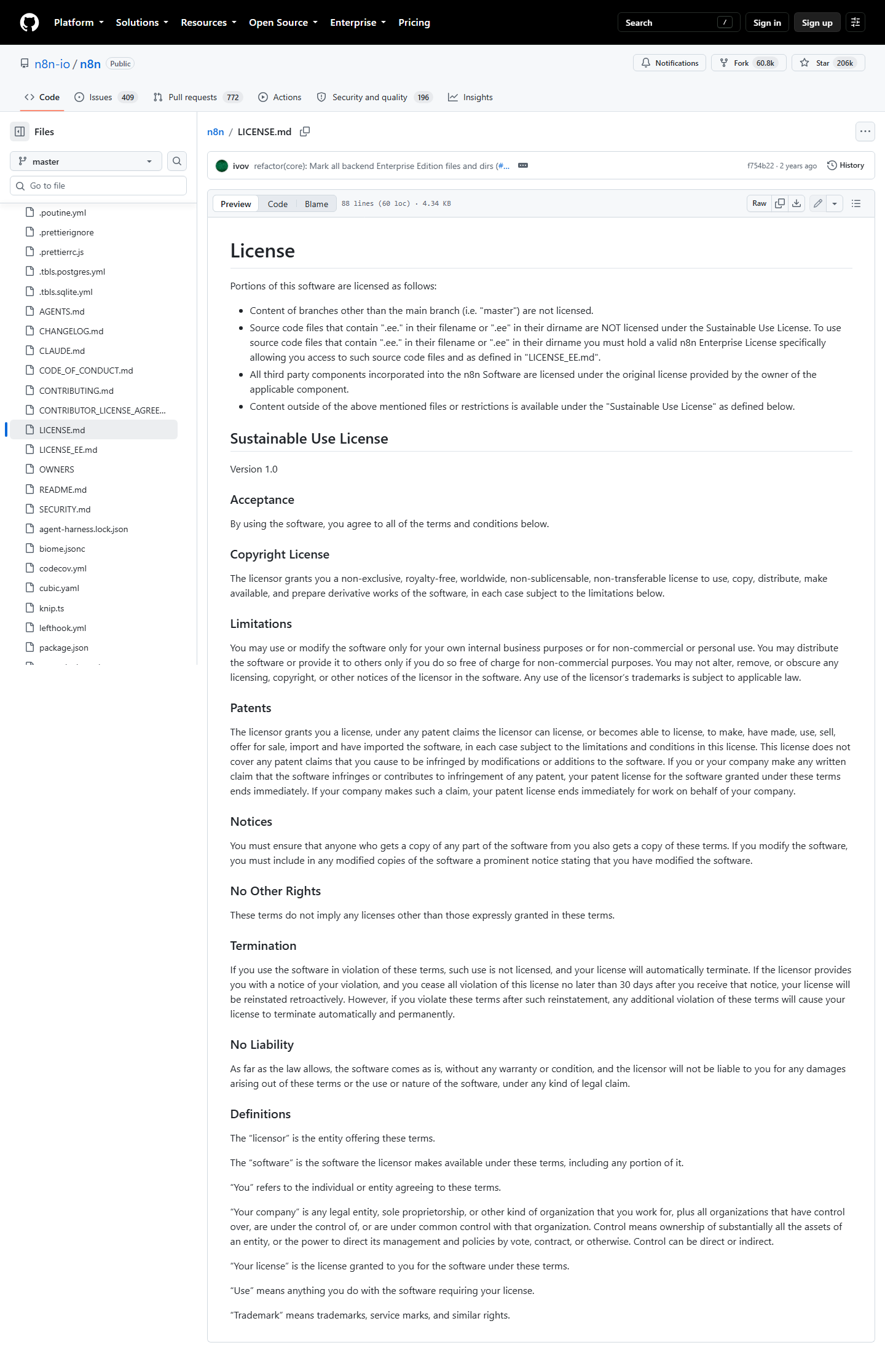
license file, LICENSE.md, is titled “Sustainable Use License, Version 1.0” (not 1.1, as
some third-party writeups report), and GitHub’s own license field for the repo reads “Other”,
not an SPDX open-source id.
The repo says this about itself, and the wording is deliberate: n8n calls its distribution fair-code and lists “Source Available” as the property — visible code you may run under restrictions, which is a different promise from MIT/Apache/GPL.
What the license file actually says (captured 2026-09-21)
The operative limitation, verbatim from LICENSE.md:
“You may use or modify the software only for your own internal business purposes or for non-commercial or personal use. You may distribute the software or provide it to others only if you do so free of charge for non-commercial purposes.”
Plus a structural split that most summaries skip:
- “.ee.” files are a separate license. Anything whose filename or directory contains
.ee.is excluded from the Sustainable Use License and requires holding an n8n Enterprise License (LICENSE_EE.md). The free self-hosted build still exists, but the enterprise feature source is not under it. - Violation terminates automatically, with a 30-day cure window on first notice.
Why that fails the open-source definition is mechanical: the Open Source Definition forbids discriminating against fields of endeavor (OSD §5) and requires free redistribution (§0–2). “Only internal business purposes” and “distribute only free of charge for non-commercial purposes” are exactly a field-of-use restriction and a redistribution restriction. n8n is not hiding anything — the license has always been this clear. The confusion is that a source-available license with sane-sounding restrictions (“don’t resell our product”) reads to most buyers as “open source”. It isn’t one, and if your deployment is anything like offering n8n-powered automation to clients, the difference is legal, not cosmetic.
What you can and cannot do, in practice
| Scenario | Community Edition under SUL v1.0 |
|---|---|
| Automate your own company’s workflows, self-hosted, forever | ✅ free |
| Modify it internally, keep changes private | ✅ |
| Ship it to a client / host it for others as a paid service | ❌ outside “internal business purposes”; needs n8n’s paid licensing |
| Fork and sell a competing automation cloud | ❌ this is the case the license exists for |
Use .ee.-licensed features without an Enterprise License |
❌ excluded from SUL entirely |
Cloud pricing is a separate question from the license — our dated breakdown is in n8n pricing (cloud Starter €20/€24 annual/monthly, no free cloud tier — which is itself a consequence of this license: the “free tier” is a self-hosted, source-available build, not a service).
Honest corrections to our own archive
This page exists partly because we repeated the wrong wording. Our earlier
n8n pricing check (2026-09-16) described the Community Edition as “free & open
source” and the pricing page listed it as “MIT-style license”. Both were
wrong against today’s first-hand read of LICENSE.md and are corrected in place. Compare a tool
that really is copyleft-open on this point: n8n alternatives documents
Windmill’s AGPLv3 backend plus its own “no resale / no managed service” CE clause — restricted
free self-hosting is a spectrum, and n8n sits at the commercial-protection end of it.
For a genuinely open alternative you may embed and resell, the license check to run is the same
one this page ran: read LICENSE.md raw, not the README’s marketing line.
What we did not verify
- Star/fork/issue counts are a single same-day API read (2026-09-21);
open_issues_count(1,180) includes pull requests, GitHub’s field mixes them. - We did not audit which shipped features correspond to
.ee.paths — the file-naming rule is quoted from the license header itself. - Whether a commercial license exception, partnership terms, or an newer license text exists
outside the repository — only what
masterships today was checked. - The hosted cloud’s terms of service were not read in this pass; this page is about the code license only.
Verdict (terms-level, no score)
No rating — this is a license question, not a product test. The answer to the title: n8n is free to self-host for your own business, and not open source. For internal automation that’s functionally almost the same thing; for anything you resell, embed in a product, or offer as a service, it is a wall — and the wall is written in one page of English most people never open.
Methodology & sources
github.com/n8n-io/n8n/LICENSE.md— raw file and rendered page captured 2026-09-21; full text archived ateval-ops/runs/2026-09-21-group8/n8n-license-page.txt(88 lines; “Sustainable Use License” + “Version 1.0” and the limitation paragraph quoted above are literal).- GitHub REST API
repos/n8n-io/n8n— queried 2026-09-21 (UTC): 205,521 stars, 60,818 forks, 1,180 open issues+PRs,pushed_at2026-09-21T09:27:34Z,license.spdx_id = NOASSERTION. Note: a secondary-index figure of “229.9k stars” that circulated in our research pass was rejected — the live API contradicts it. - Repository README wording (“fair-code”, “Source Available”) — matched in the 2026-09-21 repo page capture (evidence image 2).
- Related pages: n8n pricing, n8n vs Zapier, n8n alternatives.
- Checked 2026-09-21. Licensing can change; re-verify before citing.
Related guides
More of our n8n guides: